> Skip to main content
Category

End Inequalities

Webinar – How to achieve the SDGs despite the worsening hunger and poverty crisis?

By Events, India

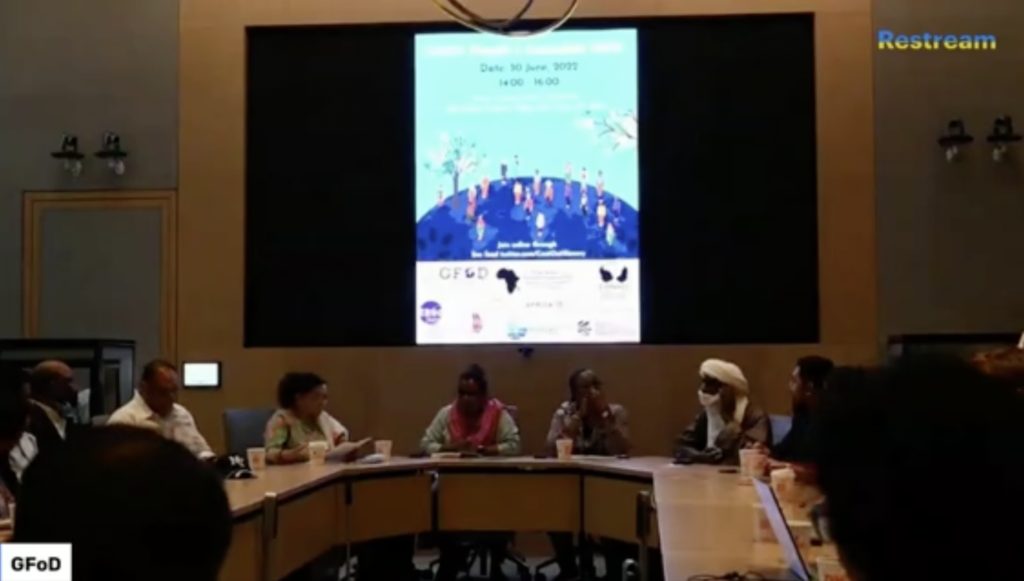
Side event to the UN High-Level Political Forum on Sustainable Development, the webinar was organised by the Global Forum of Communities Discriminated on Work and Descent (GFoD) and Global Call to Action Against Poverty (GCAP). The event focused on the discussion on “Building forward better” around four interlinked themes – vaccines, hunger, debt and social protection, and livelihood while discussing it in context of the achievement of the SDGs, especially SDG 5 using the gender lens.
Watch the video

Communities Discriminated on Work & Descent People’s Assembly – June 2022

By Events, India, Uncategorized

Side event to the UN High-Level Political Forum on Sustainable Development (UN HLPF), this Communities Discriminated on Work & Descent (CDWD) People’s Assembly was facilitated by the Global Forum of Communities Discriminated on Work and Descent, with NCDHR’s leadership.

Participants discussed achievements and obstacles regarding the rights of communities discriminated by work and descent. The forum brought together 39 CDWD rights experts, activists, and other country representatives, and had four aims:

1) to recognise the numerical strength and geographical spread of CDWD communities and the gravity of the discrimination they face;
2) to assess the level of response from individual and collective States Parties in eradicating such discrimination and violence;
3) to explore how the CDWD communities can be formally brought within the ambit of the UN Charter Bodies; and
4) to explore ways and means of generating support from the Foreign Missions

Watch the video of the meeting

Domestic Resource Mobilization Thematic Briefing cover image

Thematic Briefing on Domestic Resource Mobilization

By Global Inequalities

This briefing was developed by the Civil Society FfD (Financing for Development) Mechanism (led by SID). The briefing connects the national and international when it comes to tax policies and broader domestic resource mobilization strategies, highlighting how shaping decision-making on global economic governance at the UN has the potential to transform our global economic systems to reduce inequalities within and between countries and make them work for people and the planet.

The briefing is part of the Civil Society FfD Mechanism’s broader toolkit introducing the Financing for Development (FfD) process. This is intended to to make navigating the FfD process and its interrelated domains more accessible for a non-technical audience.

The briefing is available in English, French, and Spanish.

Domestic Resource Mobilization Thematic Briefing cover image

Cover image for the report on Indonesian Advocacy Case Studies (women protesting in solidarity, a large business suit and excavator in front of them)

2021 Advocacy Case Studies in Indonesia: The struggle of women against the domination of power in the midst of the state’s false recovery

By Indonesia

This report by Solidaritas Perempuan records numerous cases of women’s experiences of gender and economic inequality in Indonesia. From the experiences of migrant workers to women in the midst of agrarian conflicts fighting for food sovereignty, these cases from women from Aceh, Palu, Poso, Palembang, Sumbawa and Jabotabek, demonstrate the gendered nature of economic inequality across Indonesia.

The report is only available in Bahasa Indonesia.

Cover image for the report on Indonesian Advocacy Case Studies (women protesting in solidarity, a large business suit and excavator in front of them)

Food estate = Forced cultivation?

By Indonesia

From school books we know that forced cultivation systems were introduced by the Dutch colonial government through Governor General van den Bosch. Today, almost 200 years after that dark period, we seem to be able to witness it again on the land of Kalimantan through the Food Estate which is a National Strategic Project during the era of President Jokowi’s government.

As KPA Secretary General Dewi Sartika said, “if analyzed, the Food Estate system is actually similar to the forced cultivation system, so it can be concluded that Indonesia’s economic policies have returned to the era of colonialism.”

Women’s Portrait – Zainab, a fisher woman from Makassar

By Indonesia

Mid-2017, fishermen were prohibited from crossing, installing nets, and carrying out fishing activities in locations claimed by the company PT. Pelindo IV for the Makassar New Port development project. Mrs. Zainab, a fisher woman from Makassar, explains how coastal women were impoverished through policy papers and company lobbying.