This national report provides an analysis of the negative impacts of the COVID-19 pandemic on safai karmachari communities and how they were subjected to higher risks and significant challenges due to caste discrimination. The report includes several case studies that share the stories of what people from the safai karmachari community had to face in this period.
This report provides a national analysis of the situation of safai karmachari communities, drawing on data collected by SKA from focus group discussions and interviews with 1,476 safai karmachari women in seven states as well as a desk review of available government data. The findings covered educational levels, employment status, economic status, livelihood opportunities, access to government entitlements, and the discrimination and challenges they experience. Finally, the report contrasts their experience to the relevant protections enshrined in the Indian constitution.
In 2024, Solidaritas Perempuan recorded the experience of collective resistance and the layered situation of women against structural impoverishment through a Advocacy Annual Report (catahu). Catahu is recorded and documented with the Solidaritas Perempuan community as an effort to voice the situation and various feminist initiatives continuously and consistently to encourage the recognition and fulfillment of women’s rights.
The track record of women’s resistance stories is expected to foster a spirit of solidarity in waging collective resistance. In addition, Catahu 2024 can also contribute as a strategic document to support the advocacy work of Solidaritas Perempuan in realizing women’s human rights and equality in various domains amid layers of oppression due to the global economic power paradigm and the patriarchal political system that impoverishes women.
The National Executive Board of Solidaritas Perempuan expresses its highest appreciation to women at the grassroots level who have consistently remained in the line of resistance. In addition, we also express our gratitude to all administrators, members, and activists of Solidaritas Perempuan who continue to tirelessly maintain solidarity in strengthening and expanding the feminist political movement of the Solidaritas Perempuan.

This briefing was created by the CSO FfD Mechanism for activists and advocates who are interested in getting involved in or learning more about how global economic governance relates to different sectoral and/or local and national struggles in Asia – including feminist movements, food sovereignty and land rights movements, climate justice activists, youth and student movements, human rights advocates, and more.

The Dalit and Adivasi Budget Analysis (DABA) provides a thorough analysis of the Union Budget and examines the budget allocation for the Scheduled Castes and the Scheduled Tribes. In 2023, the findings were particularly concerning and newsworthy, as numerous government schemes intended to support these groups have had reduced allocations, while many general schemes are counted as part of the budget for these groups, although they are not directly targeted to them.
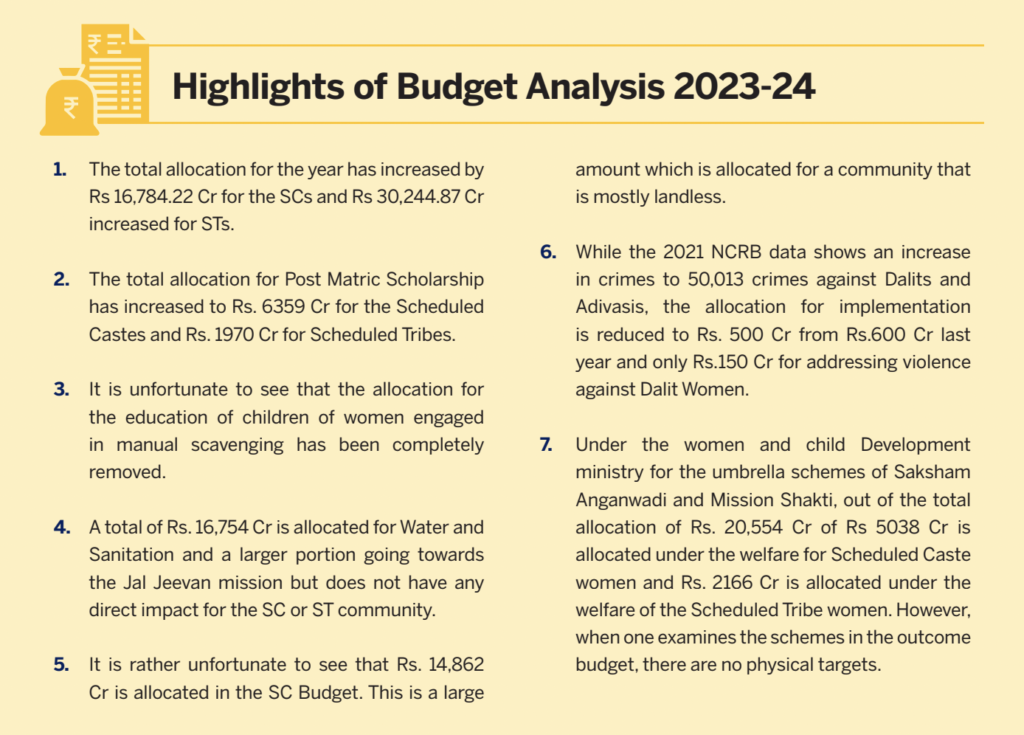
Contrary to the commitment to end manual scavenging, no funds were allocated for the rehabilitation of manual scavengers under the self-employment scheme, the scholarship programme for children of people engaged in manual scavenging has been dropped, and the National Safai Karmachari Finance and Development Corporation received a negligible allocation.
“[The] budget fails to take notice of hundreds of deaths taking place in sewers or septic tanks, all these years, whereas we at Safai Karamchari Andolan have been demonstrating on the streets daily for the last 264 days in various parts of the country, demanding to put a complete halt on deaths taking place in sewers and septic tanks. Ironically, since we started this #StopKillingUs campaign on May 11, 2022, there have been more than 50 deaths of Indian citizens inside sewers and septic tanks. But, governments are mum on that.”
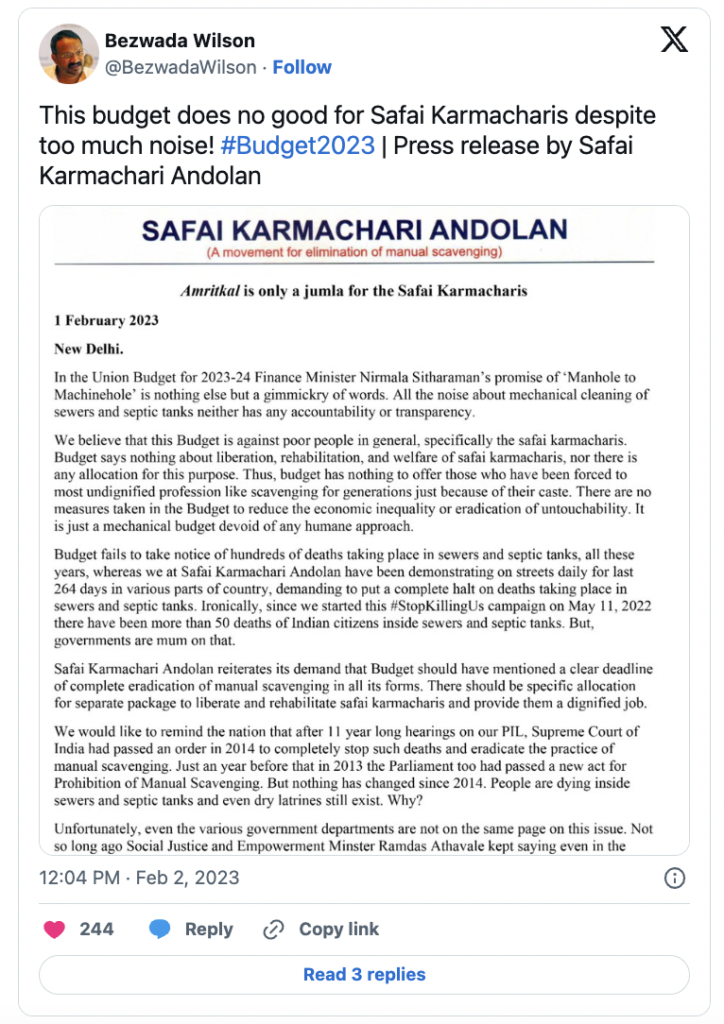
Safai Karamcharis Andolan responded to the Union Budget for 2023-2024 with a press release and a video. The organisation raised the issue of the SRMS (rehabilitation scheme) being removed from the budget and merging with the ‘NAMASTE’ scheme which only allocates budget for producing sewage cleaning machines, but not for the people.
The question was raised of why the human element has been lost and how the people themselves will be supported to step out of this work.
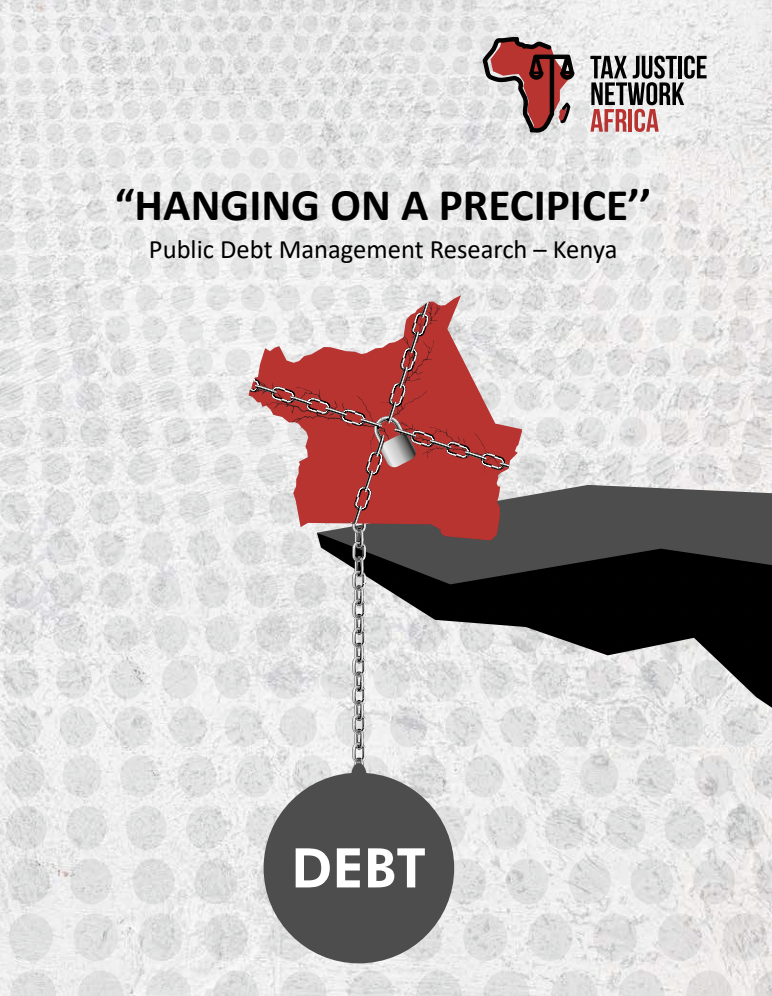
This study published by Tax Justice Network Africa sought to assess the implications of Kenya’s debt management on the advancement of human rights, and the 2030 Agenda. This necessitated the assessment of Kenya’s debt management frameworks, analysis of the implications of public debt on citizens, and assessment of the level of adoption of the 2030 Agenda in different facets of Kenya’s public finance space. The study was guided by research themes developed from the research questions.
The research themes included:
• Debt servicing and expenditure on sectors of the economy (including pro-poor sectors)
• Integration of human rights and the 2030 Agenda in Kenya’s planning and budgeting frameworks
• Kenya’s Debt data transparency
• Kenya’s Debt sustainability
• Kenya’s involvement in the multilateral agenda on debt
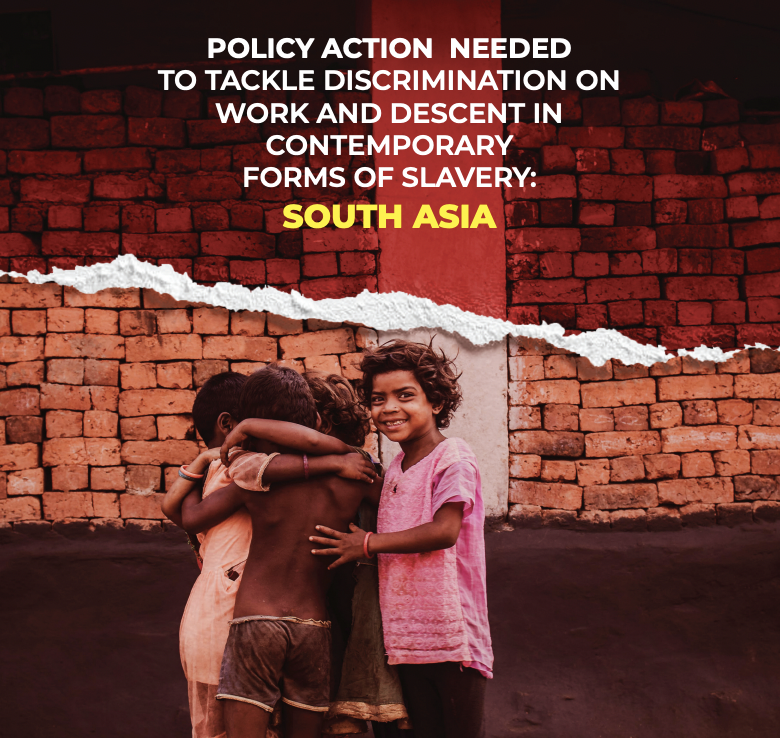
Modern slavery is the recruitment, movement, harbouring or receiving of people through the use of force, coercion, abuse of vulnerability, deception or other means for the purpose of exploitation. The victim under modern slavery is, therefore, confronted with threats, violence and abuse of power. Modern slavery occurs in different situations in which a victim is severely exploited for the gain of the perpetrator, either personal or commercial. It can take various forms such as bonded labour/debt bondage, forced labour, forced child labour, sex trafficking, child sex trafficking, domestic servitude and unlawful recruitment and use of child soldiers.
‘Discrimination based on work and descent’ (DWD) is the UN terminology for caste discrimination. It affects over 260 million people globally, it has its roots in the centuries-old caste system of India and is prevalent in India, Nepal, Pakistan, Bangladesh, Sri Lanka and the Indian diaspora, owing to shared histories, borders and people.
The briefing demonstrates the links between caste-based discrimination and forms of modern slavery in South Asia, including the practice of forced labour in the form of manual scavenging and presents recommendations for policy-makers at various levels.
