This briefing presents data on the situation of Dalit women generally, and Dalit women engaged in manual scavenging specifically – outlining the discrimination and disadvantages they face, and the obstacles they encounter in trying to improve their economic situation. The report also presents an overview of existing governments schemes for rehabilitation and access to alternative livelihoods and provides a list of recommendations.
Together with Part 2, these briefings show the interlinkages between education and the economic disadvantages faced by children from the manual scavenging community. The briefings provide an overview of the different government programmes and scholarships intended to address this problem, outline the challenges faced by the children in trying to access these entitlements, analyse recent budget allocations for these programmes (including the highly concerning removal of a separate scholarship specifically for children of those engaged in manual scavenging) and propose recommendations.
Together with Part 1, these briefings show the interlinkages between education and the economic disadvantages faced by children from the manual scavenging community. The briefings provide an overview of the different government programmes and scholarships intended to address this problem, outline the challenges faced by the children in trying to access these entitlements, analyse recent budget allocations for these programmes (including the highly concerning removal of a separate scholarship specifically for children of those engaged in manual scavenging) and propose recommendations.
Achieving gender equality is a complex process and government policies play a vital role in it. Gender gaps across the country have been worsened by cultural and societal norms and most recently by the pandemic. One of the ways to ensure equality in public expenditure is to employ Gender Responsive budgeting from the formulation stage itself. The status of the gender-responsive budget is a major cause of concern particularly from the Dalit perspective. It is unclear, vague and unjust considering that the Dalits are the most vulnerable community and are marginalized in the majority of the socio-economic and educational sectors. Producing a gender budget statement is the mechanism adopted by the Indian government, however, the status of Dalit women remains the same with almost negligible allocation for them in FY2023-24 too.
The Indian Constitution, in its preamble, guarantees equality and social justice for all citizens. Yet, the deeply entrenched practice of manual scavenging, a relic of the caste system, continues to blight the lives of millions, particularly Dalits. This abhorrent practice, despite being legally prohibited, persists due to the complex interplay of socio-economic, political, and cultural factors.
Manual scavenging is defined under the Prohibition of Employment as Manual Scavengers and their Rehabilitation Act, 2013, as any person engaged in manually handling human excreta. This hazardous and dehumanising task of cleaning human excreta from dry latrines, septic tanks, and open drains, is inherently linked to caste discrimination. Dalits, historically relegated to the lowest rung of the social hierarchy, have been traditionally assigned this degrading occupation. This systemic oppression perpetuates a cycle of poverty, ill health, and social exclusion for generations.
While the Prohibition of Employment as Manual Scavengers and their Rehabilitation Act, 2013, prohibits manual scavenging, its effective implementation requires adequate financial resources for rehabilitation and alternative livelihood programs.
While the challenges faced by manual scavengers are multifaceted, the situation is particularly dire for Dalit women. They bear the brunt of the social stigma, face heightened risks of sexual violence and exploitation, and have limited access to education and employment opportunities.
The intersectionality of caste, gender, and age discrimination creates a unique set of challenges for these women, exacerbating their vulnerability and hindering their socio-economic mobility. This section aims to shed light on the lived realities of Dalit women engaged in Manual Scavengings, their daily struggles, the psychological impact of this occupation, and the obstacles they face in escaping this cycle of poverty and discrimination. By understanding their experiences, we can develop targeted interventions to address their specific needs and empower them to lead dignified and fulfilling lives.
Social justice is the aspiration of the Indian Constitution that it strives to achieve. The Constitution mandates the state to ensure and secure social justice and order based on equal opportunity so that it is not denied to any citizen on any grounds. When we examine the country based on five basic indicators of poverty, inequality, employment, violence, and atrocities, the numbers are indicative of the marginalization of communities such as the Dalits and Adivasis, leading to widening inequalities.
‘Entitlements to economic rights become narrower and narrower the farther down the hierarchical ladders of the caste system. Without intervention, classically untouchables, or Dalits, who lie at the very bottom of the social order, find themselves restricted to the most despised occupations and the lowest wages’ writes Katherine S. Newman and Sukhadeo Thorat.
Discrimination, exclusion, inequality, and the system of untouchability based on caste continue to operate and thrive very securely in the country. Despite formal legal protection by the law, discriminatory norms continue to be reinforced by the state and non-state actors often through violence. There are very strong caste divisions between Dalits and other caste groups in housing, religious practices, employment, and marriage, among many others. The incidence of violence against the Dalit has not shown a decline and remains persistent in different forms like murder, individual and gang rape, physical assault, verbal abuse, naked parading, and so forth.
Exclusion and discrimination are not only visible in the civic and political spheres but also in the economic sphere, particularly in terms of occupation, labor employment, and market arrangement. Dalits are often restricted to particular kinds of occupations often considered polluting with low wages and with very less options of mobility.
Manual scavenging is one of the definitive examples reflecting their economic position in the labor market. Based on the caste hierarchy, Dalits make up the majority of the manual scavengers in the country, out of which Dalit women are seen in huge numbers. The entrenched concept of pollution and discrimination connected with manual scavenging makes it difficult for them to find any alternative livelihood opportunities pushing them into the age-old vicious circle of poverty and exclusion.
In our country, the accurate figure related to the population of persons engaged in manual scavenging is a subject of dispute. So, the real picture is away from the public view.
In India, it is sad to note that over the last few years, the deaths of sewage workers have increased, with 634 deaths related to manual scavenging recorded in the last twenty-five years. As per the data provided by Safai Karamchari Andolan roughly 45 deaths are reported annually in India while admitting that many of them even go unreported. With a lack of minimum wages, lack of protective gear, absence of alternate economic opportunities, social security, and health risks the practise of manual scavenging poses serious questions on the human rights situation in our country.

The Dalit and Adivasi Budget Analysis (DABA) provides a thorough analysis of the Union Budget and examines the budget allocation for the Scheduled Castes and the Scheduled Tribes. In 2023, the findings were particularly concerning and newsworthy, as numerous government schemes intended to support these groups have had reduced allocations, while many general schemes are counted as part of the budget for these groups, although they are not directly targeted to them.
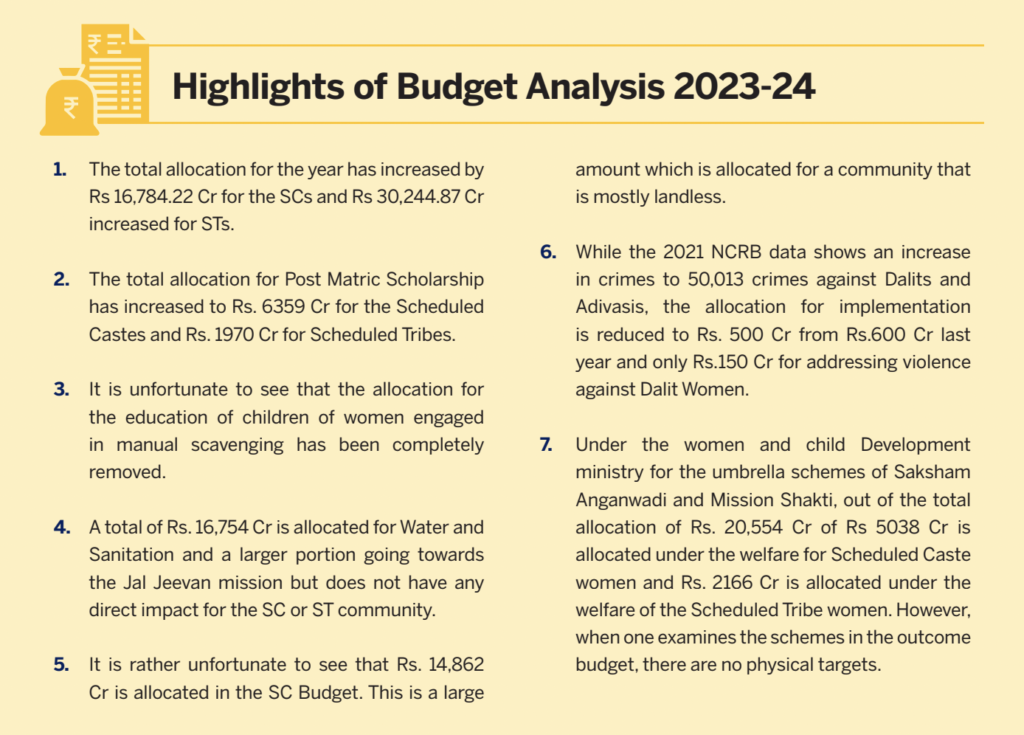
Contrary to the commitment to end manual scavenging, no funds were allocated for the rehabilitation of manual scavengers under the self-employment scheme, the scholarship programme for children of people engaged in manual scavenging has been dropped, and the National Safai Karmachari Finance and Development Corporation received a negligible allocation.

This report, by the National Campaign on Dalit Human Rights provides insight into the lived realities and stories of women and girl sanitation workers in two states in India (Madhya Pradesh and Maharashtra). Their voices often go unheard and their lives made invisible due to the stigma attached to their work. Based on a combination of a literature review and focus group discussions with women and girl , the report helps the reader to understand the issues and challenges of daily life from their lens, and the hurdles they face in accessing their rights and entitlements. The report also provides an analysis of existing schemes and budget allocation for sanitation workers and the gaps that must be addressed by the government and society at large.

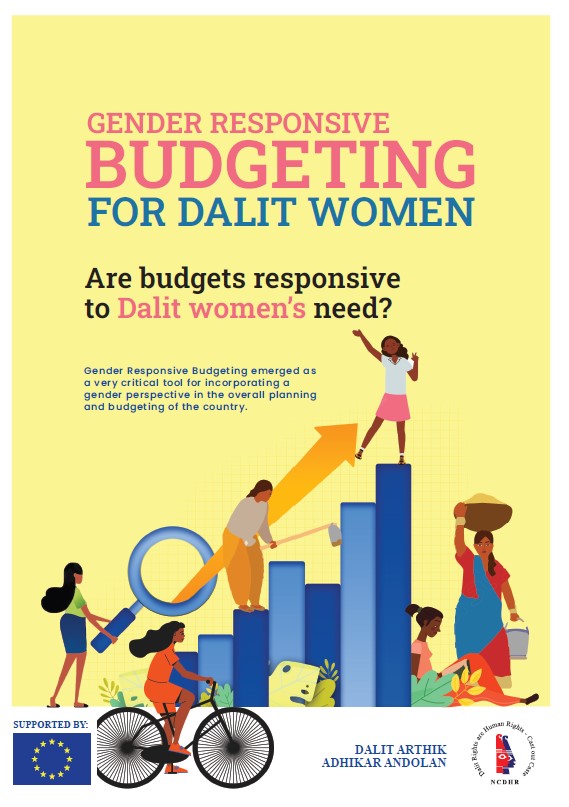
Gender Responsive Budgeting has emerged as critical tool for incorporating a gender perspective into India’s overall planning and budgeting. But are India’s budgets responsive to Dalit women’s needs? NCDHR analyses whether India’s budgets in 2019-2023 have been successful in reaching the most marginalised women after two decades of gender responsive budgeting. The report also proposes changes that the union government can make to make its gender responsive budgeting more inclusive of Dalit women.
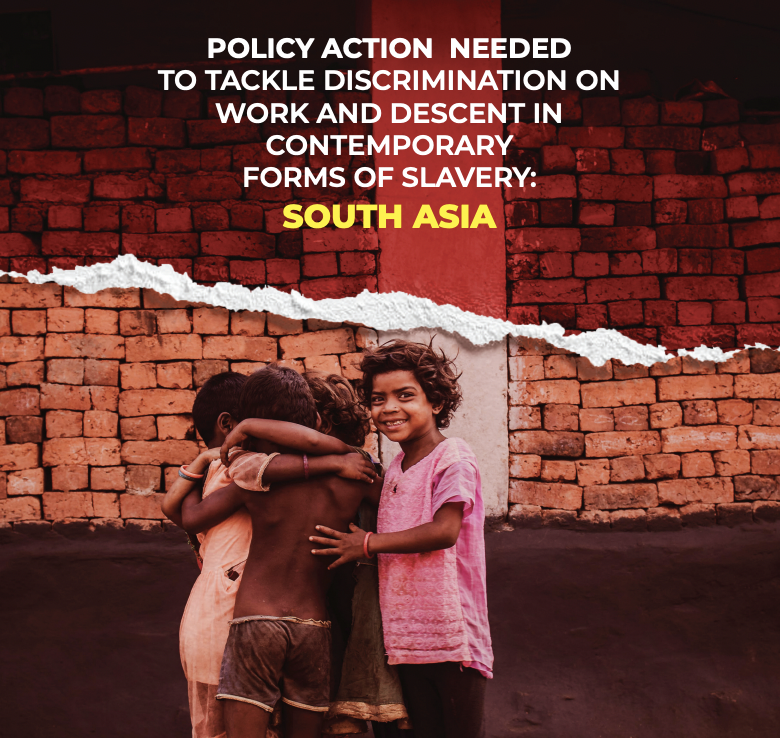
Modern slavery is the recruitment, movement, harbouring or receiving of people through the use of force, coercion, abuse of vulnerability, deception or other means for the purpose of exploitation. The victim under modern slavery is, therefore, confronted with threats, violence and abuse of power. Modern slavery occurs in different situations in which a victim is severely exploited for the gain of the perpetrator, either personal or commercial. It can take various forms such as bonded labour/debt bondage, forced labour, forced child labour, sex trafficking, child sex trafficking, domestic servitude and unlawful recruitment and use of child soldiers.
‘Discrimination based on work and descent’ (DWD) is the UN terminology for caste discrimination. It affects over 260 million people globally, it has its roots in the centuries-old caste system of India and is prevalent in India, Nepal, Pakistan, Bangladesh, Sri Lanka and the Indian diaspora, owing to shared histories, borders and people.
The briefing demonstrates the links between caste-based discrimination and forms of modern slavery in South Asia, including the practice of forced labour in the form of manual scavenging and presents recommendations for policy-makers at various levels.
